What This Chapter Is Really About
This chapter is all about the corporate form of ownership: how corporations are governed, how stock ownership works, and every equity transaction a corporation goes through. Understanding this chapter will make you a more informed reader of financial news and give you vocabulary and intuition that goes well beyond what most people have.
🧠 The big picture: Liabilities answer "what do we owe outsiders?" Equity answers "what do the owners actually own?" Chapter 10 is all about who owns the company, how that ownership is structured, and every transaction that changes it.
1. Forms of Business Ownership — and Why Corporations Dominate
There are three main forms: sole proprietorships, partnerships, and corporations. Each has its advantages and disadvantages — but corporations are the dominant form for large businesses, and here's why.
| Feature | Corporation | Proprietorship / Partnership |
|---|---|---|
| Limited liability | ✅ The most an owner can lose is the value of the stocks they own — and no more. Personal assets are protected. | ❌ Owner(s) are personally liable for all debts. |
| Raising capital | ✅ If a corporation needs cash, it can sell some stock to new investors — a relatively easy way to raise large amounts of capital. Shareholders can also buy or sell their stake freely in the market. | ❌ Limited to the owner's wealth and a small number of partners. |
| Transfer of ownership | ✅ Shares trade freely — no partner consent required. | ❌ Requires agreement from all existing partners. |
| Double taxation | ❌ Corporations pay taxes on their earnings, and then shareholders pay taxes again on any distributions received as dividends. | ✅ Profits pass through to the owner's personal return — only taxed once. |
| Government regulation | ❌ More paperwork — corporations must file at both the state and federal level. | ✅ Less regulation. |
🧠 The financing progression: Most corporations follow a path: founders' equity → friends and family → angel investors and venture capital → finally the IPO (initial public offering), where shares are first sold to the general public. The IPO is the last step in that traditional sequence — and it's a big deal.
🚨 Common Trap: Thinking double taxation means corporations pay "twice as much" tax. It means the same dollar of profit gets taxed at the corporate level AND again when paid out as dividends. It's the double-taxation of income, not a doubled rate.
2. Corporate Governance — Who Runs the Company
Corporations are owned — and ultimately governed — by their shareholders. But shareholders don't run the company day-to-day. There's a hierarchy:
Key point: The CEO is an employee of the shareholders. We often think of the CEO as "the top of the organization" — and they have the corner office — but they ultimately answer to the board and the individual shareholders who elected it.
3. Two Main Classes of Stock
There are two main classes of stock, and understanding the difference is foundational to everything that follows.
| Class | What it is | Who buys it | Voting rights |
|---|---|---|---|
| Common Stock | What we normally think of as "stock" — traded on stock exchanges like the NYSE or NASDAQ. | General public, investors, funds. | ✅ Yes — votes in shareholder elections. |
| Preferred Stock | Rare, usually not traded on public markets. | Specific investors seeking steady income. | ❌ Usually no — gives up voting rights in exchange for dividend preference. |
Preferred stock also has subtypes based on its features:
- Convertible — can be traded for a set number of common shares, if the holder chooses.
- Redeemable — can be "cashed in" with the company at a pre-determined price.
- Cumulative — missed dividends build up and must be paid before common shareholders get anything.
- Non-cumulative — missed dividends are simply forfeited; the company owes nothing extra.
🧠 Preferred stock in one sentence: Preferred shareholders get paid dividends before common shareholders — but in exchange, they usually give up voting rights. They are like a hybrid between a bond (fixed dividends) and common stock (ownership stake).
4. Par Value — A Legal Label, Nothing More
Par value is one of the most misunderstood concepts in accounting. Here's the bottom line: par value has nothing to do with market value. It is really not much more than a legal label — a par value dollar amount — slapped on a share of stock when the corporation is set up. It affects the accounting, not the price.
Let's say a company sells 500 shares of $1 par value common stock to an investor for $5,000 total. The investor is paying $10 per share — $9 more than the $1 par value.
The journal entry:
Cr Common Stock 500 (500 shares × $1 par)
Cr Additional Paid-In Capital (APIC) 4,500 ($5,000 − $500)
The Common Stock account only ever shows the par value portion ($1 × shares). The APIC account holds everything else — the excess over par that investors paid because they thought the company was worth more than the legal minimum.
Why does this matter? A corporation's "legal capital" is the total par value of all shares issued. This amount generally cannot be returned to shareholders as dividends — it must stay in the company to protect creditors. APIC, on the other hand, is additional capital contributed above the legal minimum.
No-Par Stock — When There's No Par
Some companies choose to have no-par stock. The accounting is simpler — the entire proceeds go to the Common Stock account, and there is no APIC:
Cr Common Stock 5,000
Why this matters — and how it would differ on an exam: If the same 1,000 shares had a $1 par value and were issued at $5 per share, the entry would be: Dr Cash $5,000 / Cr Common Stock $1,000 / Cr APIC $4,000. With no-par stock, there is no APIC — the entire $5,000 is recorded as Common Stock. The key exam answer: the entire proceeds go to Common Stock; no APIC is recorded.
5. Preferred Stock — Dividends and the Cumulative Rule
Preferred stock often carries dividends expressed as a percentage of par value. For example: 8% of $10 par value = $0.80 per share per year.
Annual Preferred Dividend = Shares × Par Value per Share × Dividend Rate
Example: 1,000 shares, $50 par, 7% preferred → 1,000 × $50 × 0.07 = $3,500 per year
Cumulative vs. Non-Cumulative — The Most-Tested Distinction
Companies in a given year may decide to pay dividends — or not. If they do pay, preferred shareholders get paid before common shareholders. But here's where it gets important:
| Cumulative Preferred | Non-Cumulative Preferred | |
|---|---|---|
| Missed dividends | Build up as dividends in arrears — owed and must be paid eventually | Missed dividends are forgiven — the company owes nothing |
| Before common gets anything | Must pay all arrears plus current year dividends first | Must pay only current year dividends first |
🧠 The memory hook — cumulative preferred shareholders are like landlords: If the tenant misses rent in January, the landlord doesn't just forget about it — they keep a record of what's owed. With cumulative preferred, the company "owes" those missed dividends and must pay them before common shareholders get a dime. With non-cumulative preferred, it's as if the missed rent is simply forgiven.
Company has 2,000 shares, $50 par, 8% cumulative preferred. Annual dividend = 2,000 × $50 × 8% = $8,000 per year. No dividends were paid in Year 1 or Year 2. In Year 3, the company declares $30,000 in total dividends.
Cumulative preferred — Year 3:
- Dividends in arrears (Year 1 + Year 2): 2 × $8,000 = $16,000
- Year 3 current dividends: $8,000
- Preferred total: $24,000
- Remaining to common: $30,000 − $24,000 = $6,000
Non-cumulative preferred — Year 3:
- Year 1 and Year 2 dividends: forgiven — $0
- Year 3 current dividends: $8,000
- Preferred total: $8,000
- Remaining to common: $30,000 − $8,000 = $22,000
Sunset Resorts issues 1,000 shares of $25 par value preferred stock at $30 per share — the market price exceeds the par value, so investors pay a premium above par.
Cr Preferred Stock 25,000 (1,000 shares × $25 par)
Cr Additional Paid-In Capital — Preferred Stock 5,000 (1,000 × ($30 − $25))
The same logic as common stock issued above par: the par value goes in the stock account; the excess over par goes to APIC. This applies to both common and preferred stock.
Crimson Beverages issues 2,000 shares, $50 par, 9% cumulative preferred. Annual dividend = 2,000 × $50 × 9% = $9,000 per year. The company cannot pay dividends in Year 1, then declares $25,000 in Year 2.
Cumulative — Year 2:
- Year 1 arrears (missed): $9,000
- Year 2 current dividend: $9,000
- Preferred total: $18,000
- Remaining to common: $25,000 − $18,000 = $7,000
Non-cumulative — Year 2:
- Year 1 dividends: forgiven — $0
- Year 2 current dividend: $9,000
- Preferred total: $9,000
- Remaining to common: $25,000 − $9,000 = $16,000
The only difference: with non-cumulative preferred, the missed Year 1 dividend does not accumulate — it is simply lost. With cumulative, it builds up and must be paid before common shareholders receive anything.
🚨 Common Trap: Giving common shareholders any dividends before clearing cumulative preferred arrears. If cumulative preferred has missed dividends, that money must be paid to preferred shareholders FIRST — all arrears, before common gets anything. Skipping the arrears is the most common exam mistake on this topic.
6. Treasury Stock — The Company Buying Its Own Shares
Companies may buy their own stock back from shareholders. When a company owns shares of its own stock, this is called Treasury Stock. Here are the main reasons a company does this:
- They feel the stock price is undervalued — buying it back is a good investment of excess cash
- They need shares to compensate employees (stock-based compensation)
- They want to return value to shareholders without paying dividends — buying back stock doesn't create a tax event for shareholders the way dividends do
Treasury stock has a negative impact on stockholders' equity. When a company buys its own shares, it reduces the equity of all shareholders — because the company now holds an asset that belongs to the owners, not to the company as an independent entity. Treasury stock is a contra-equity account.
Recording Treasury Stock Transactions
Blue Ridge Corp issues 1,000 shares of $1 par common stock at $18 per share. Later, Blue Ridge repurchases 100 of those shares at $22 per share (the current market price). Then it resells all 100 shares at $25 per share.
Step 1 — Original issuance:
Cr Common Stock 1,000
Cr APIC 17,000
Step 2 — Repurchase at $22/share (cost method):
Cr Cash 2,200
Step 3 — Resale at $25/share (above cost — gain goes to APIC):
Cr Treasury Stock 2,200 (original cost)
Cr APIC — Treasury Stock 300 ($2,500 − $2,200)
🚨 Common Trap: Recording a gain or loss on treasury stock resales through the income statement. Treasury stock transactions never touch income — gains and losses go directly to the APIC — Treasury Stock account (or reduce APIC if sold below cost). Treasury stock is a contra-equity account, not an asset.
7. Retained Earnings and Cash Dividends
Retained Earnings (RE) is the cumulative total of all net income the company has earned over its life, minus all dividends it has paid out to shareholders. It's not cash — it's the accumulated profits kept in the business rather than distributed.
Ending RE = Beginning RE + Net Income − Dividends Declared
Or rearranged to solve for dividends:
Dividends = Beginning RE + Net Income − Ending RE
Maple Ridge Corp's Retained Earnings increased by $1.4 million during the year. Net income for the year was $4.5 million. What dividends were declared and paid?
Change in RE = Ending RE − Beginning RE = $1.4M
So: Dividends = $4.5M − $1.4M = $3.1 million
🧠 The dividend declaration chain: When a company declares a dividend, it records a liability (Dividends Payable). When it pays the dividend, it reduces that liability and cash. The declaration date is when the legal obligation is created — that's when the journal entry happens.
8. Stock Dividends vs. Stock Splits — They Sound Similar, But They're Not
These two transactions are often confused — they both involve increasing the number of shares — but they are fundamentally different in economic substance and accounting treatment.
| Stock Dividend | Stock Split | |
|---|---|---|
| What happens | Company converts some retained earnings into new shares of stock and distributes them to existing shareholders. | Company doubles (or triples, etc.) the number of shares each shareholder owns — no value changes hands. |
| Journal entry required? | ✅ Yes — RE is reduced, Common Stock (and sometimes APIC) is increased. | ❌ No — only a note in the financial statements. |
| Par value per share | Usually stays the same (new shares issued at par or stated value). | Is reduced proportionally (2-for-1 split → par halves). |
| Total equity changes? | Yes — RE decreases; total equity unchanged. | No — pure reclassification, no equity change at all. |
| Why do it? | Signal to the market that management is optimistic; reward shareholders without using cash. | Bring down a stock price that has gotten too high for many retail investors to afford. |
Before the split: 29,000 shares outstanding, $1 par value, market price $34 per share.
After a 2-for-1 split:
| Before Split | After Split | |
|---|---|---|
| Shares outstanding | 29,000 | 58,000 |
| Par value per share | $1.00 | $0.50 |
| Market price per share | $34.00 | $17.00 |
| Total market value held | 29,000 × $34 = $986,000 | 58,000 × $17 = $986,000 |
Notice: the total value of each shareholder's investment is exactly the same after the split — you just own twice as many shares at half the price. No journal entry. Pure paperwork.
A company declares a 10% stock dividend when it has 10,000 shares outstanding, $1 par value, and a market price of $20/share. 1,000 new shares (10% of 10,000) are issued at market value:
Cr Common Stock 1,000 (par: 1,000 × $1)
Cr APIC 19,000 ($20 − $1) × 1,000
Retained Earnings decreases by $20,000. Total stockholders' equity is unchanged — value has just moved from RE into the capital accounts.
🚨 Common Trap: Thinking a stock split means a stock dividend journal entry. A stock split requires NO journal entry at all. Only a stock dividend requires an entry that reduces RE. When you see a question about a split, the answer is always: "no journal entry needed."
9. Earnings Per Share (EPS)
EPS tells you how much net income the company earned for each share of common stock. It's one of the most-watched numbers in all of finance — and it shows up on the income statement as a single-line item.
EPS = (Net Income − Preferred Dividends) ÷ Weighted-Average Common Shares Outstanding
🚨 Always subtract preferred dividends first. If the company has preferred stock outstanding, preferred shareholders get their dividends before common shareholders get anything. The numerator of EPS is what belongs to common shareholders — so preferred dividends always reduce the numerator.
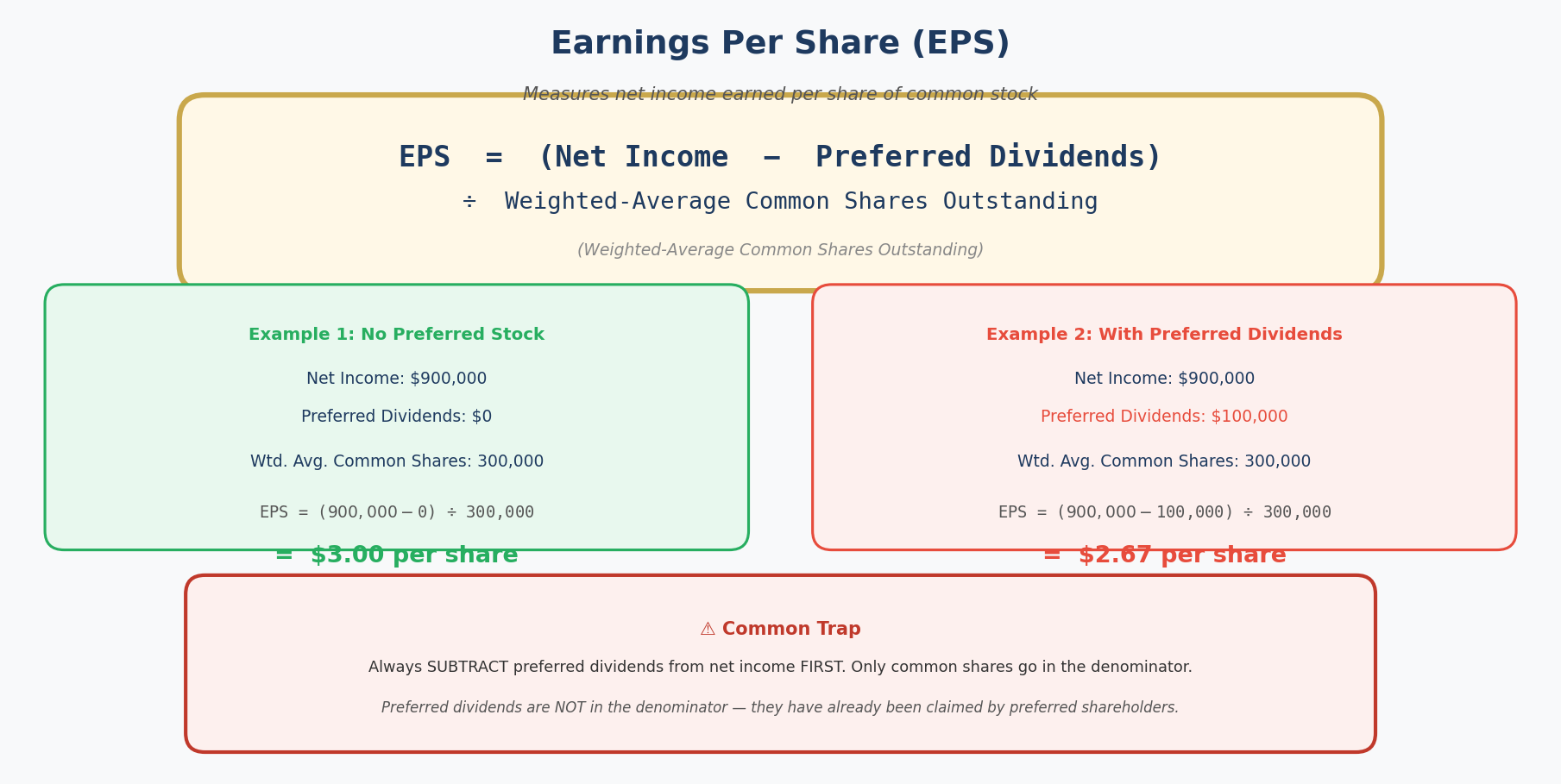
Company has: Net Income = $900,000 · Weighted-Average Common Shares = 300,000 · Preferred Dividends = $0.
Now assume the same company has $100,000 in preferred dividends:
The preferred dividends "belong" to preferred shareholders — they reduce what each common shareholder gets.
10. The Statement of Stockholders' Equity
This statement keeps track of all the changes in the ownership positions and values for shareholders over time — and it's one of the most important disclosures for understanding how your wealth as an owner is changing.
The statement ties together everything in this chapter:
- Issuances of common and preferred stock
- Treasury stock purchases and resales
- Declaration and payment of dividends
- Net income (which increases retained earnings)
- Stock dividends and splits
The core formula:
+ Common Stock Issued
+ Net Income
− Dividends Declared
± Treasury Stock Transactions
± Other Comprehensive Income Items
= Ending Stockholders' Equity
Quick Reference — Key Formulas
Common Stock issued = Shares × Par value per share
APIC = Total cash received − (Shares × Par value)
Ending RE = Beginning RE + Net Income − Dividends
Dividends = Beginning RE + Net Income − Ending RE
Treasury stock (purchase): Dr Treasury Stock, Cr Cash (at cost)
Treasury stock (resale above cost): Dr Cash, Cr Treasury Stock (cost), Cr APIC-TS
EPS = (Net income − Preferred dividends) ÷ Weighted-avg common shares
Pre-Exam Checklist
- I know the three advantages (limited liability, capital access, easy transfer) and two drawbacks (double taxation, regulation) of the corporate form
- I can trace the corporate governance chain: shareholders → board → CEO → managers
- I know common stock has voting rights; preferred stock generally does not
- I can record a stock issuance — Common Stock at par only, APIC for everything above par
- I can compute annual preferred dividends and allocate a dividend pool between cumulative preferred and common shareholders
- I know cumulative preferred carries missed dividends in arrears; non-cumulative does not
- I can record treasury stock purchase and resale (above and below cost)
- I know treasury stock is a contra-equity account — never an asset, never a gain or loss through income
- I can solve for dividends using the retained earnings rollforward
- I know a stock split requires no journal entry; a stock dividend does (reduces RE)
- I can compute EPS, subtracting preferred dividends from net income first
- I understand the Statement of Stockholders' Equity as a summary of all equity changes