Chapter 7 focuses on Long-Term Assets — the larger, more expensive assets meant to benefit your company for years: land, buildings, equipment, delivery trucks, and similar items. You've already encountered many of these concepts in this course, but in this chapter we dig much deeper.
There are two categories of long-term assets:
Tangible assets — things with physical form and substance, like land, buildings, and equipment
Intangible assets — things whose value comes from the legal rights they convey, not their physical form, like patents, copyrights, and franchise agreements
Here's the general answer to the question "What is the value of the asset?":
We record a long-term asset at its cost plus all expenditures necessary to get the asset ready for use.
That means the purchase price is just the starting point. Legal fees, title transfer costs, delivery, installation, and other related expenditures all go into the asset's cost basis. These "start-up" costs vary by asset type — the book and lecture cover the specifics for each.
Sometimes you buy multiple assets in a single deal — for example, purchasing a restaurant that includes land, a building, and equipment. When that happens, you use the Basket Purchase method: allocate the total price based on each asset's relative fair value, as determined by an independent third-party appraiser.
Under the cost principle, all costs necessary to get a long-term asset ready for use belong in the asset's cost basis — not just the purchase price.
The chapter also covers what happens when assets are no longer useful — how we dispose of them — and what happens when an asset's value drops unexpectedly and we must impair (reduce) its book value.
There are three big themes to master:
Capitalization — deciding which costs go into an asset's value vs. being expensed immediately
Depreciation / Amortization — systematically allocating the cost of those assets over their useful lives
Disposal — removing an asset from the books when it's sold, traded, or retired
The exam tests all three. Get comfortable moving between the concept, the formula, and the journal entry.
1. What Gets Capitalized — The Cost Principle
The foundational rule: all costs necessary to acquire an asset and get it ready for use go into the asset's cost. Everything else is an expense.
Land is the clearest example. Land is unique because it is not depreciated — it doesn't wear out. So every cost that gets you the land ready to use gets capitalized into the Land account.
Purchase price
Broker commissions and closing costs
Title and legal fees
Costs to prepare the site (grading, clearing)
Demolition of an unwanted old building on the land
Less: any salvage value from materials recovered during demolition
🧠 Memory hook: "Land is forever." Nothing goes into Land except costs that make the land usable as land. If you're spending money to prepare a building for use — that's Building cost, not Land cost.
📝 Worked Example: Land Cost
Harbor Corp pays $500,000 cash for land with an old warehouse. Additional costs:
Note: demolition goes into Land because the warehouse was on the land and had to be removed to use the land as intended. If a new building will be built, the demolition still belongs to Land — not to the future building.
🚨 Common Trap: Students put demolition costs into "Building." Only do that if the demolition was part of preparing a building for use — not when you're removing a structure to use the land itself.
Basket Purchases
When two or more assets are bought for a single lump-sum price, you must allocate that price based on relative fair values.
Allocation to Asset A = (Fair Value of A ÷ Total Fair Value of All Assets) × Lump-Sum Price
📝 Worked Example: Basket Purchase
Company buys land + building together for $900,000. Fair values: Land $300,000, Building $600,000.
Total fair value = $900,000. Note: that equals the purchase price, so the allocation is straightforward here.
What if the lump sum was $1,000,000 instead? Then Land = $333,333 and Building = $666,667.
🏷️ Interactive: Basket Purchase Allocation — click to open
Adjust fair values to see cost allocations shift in real time
2. Depreciation — Three Methods
Here's why all of this matters: The accrual accounting Expense Recognition Principle says we must match expenses with the revenues they help produce. Long-term assets are tricky because the benefit spans many accounting periods. The asset's useful life helps us figure out how to allocate that large cost over time. We call this cost allocation "Depreciation."
Important distinction — accounting depreciation ≠ everyday depreciation: In everyday language, "depreciation" often means a thing loses value as it gets older (like a car dropping in value as it ages). Accounting depreciation is different. We are not tracking market value when we depreciate an asset. We are allocating the cost of the asset over its useful life. This is a completely separate concept from whatever the asset might be worth if you tried to sell it on the open market.
Depreciation is an accounting method to capture the actual cost of running your business and match the cost of using assets with the revenues they help produce. Importantly, depreciation reduces net income (and taxes) in each period — but it is not an actual cash outflow. It is a cost allocation for an asset you already paid for. You're just spreading that prior purchase cost over all the years the asset will be useful.
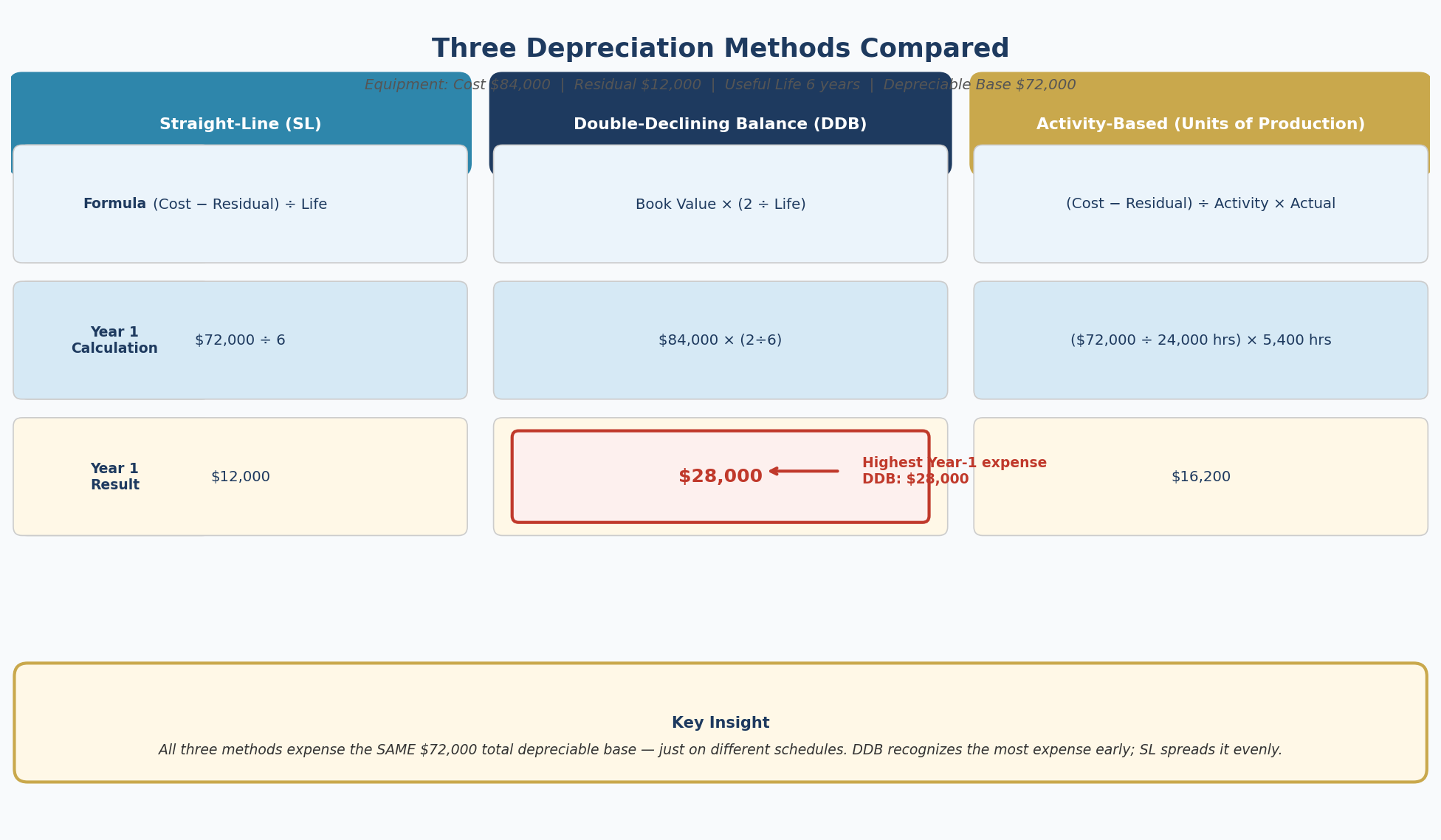
There are three depreciation methods — three different schedules for how we "spend" the depreciable base:
Straight-Line (SL) — spend it in equal annual installments
Activity-Based — spend it proportional to how hard you actually use the asset (e.g., miles driven in a truck)
Double-Declining Balance (DDB) — spend it fast at the start, slower later (accelerated)
All three methods spend the same total amount over the asset's life. They just spend it on different schedules.
As we depreciate, we accumulate that expense in an account called Accumulated Depreciation. The original cost minus accumulated depreciation gives us the Book Value of the asset at any point in time.
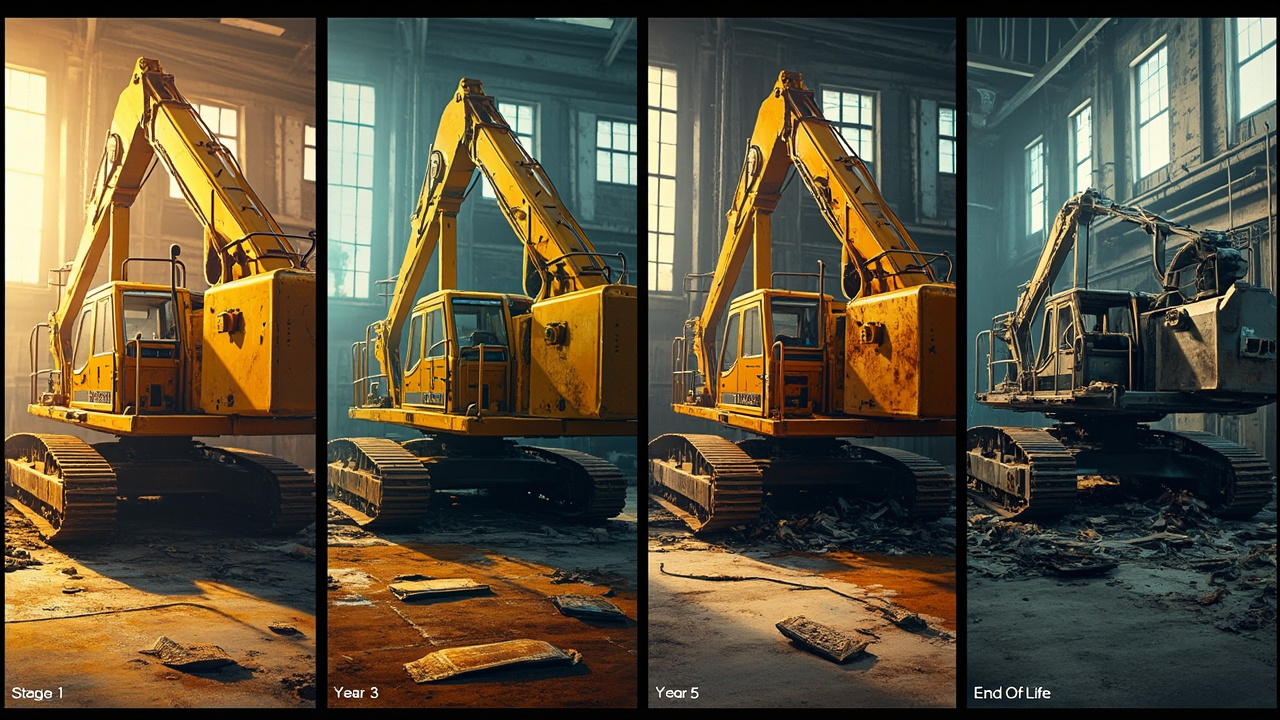
Depreciation is the systematic allocation of an asset's cost over its useful life — it spreads the cost as an expense, not a measure of physical condition or market value.
Depreciable Base = Cost − Residual Value
Straight-Line (SL)
SL Depreciation = (Cost − Residual) ÷ Useful Life
Produces the same expense every year.
Double-Declining-Balance (DDB)
DDB Depreciation = Beginning Book Value × (2 ÷ Useful Life)
Uses book value (not depreciable base), so the rate is applied to a shrinking number.
Never depreciate below residual value — if DDB would take you below, switch to straight-line for the final years.
Activity-Based (Units of Production)
Per Unit = (Cost − Residual) ÷ Total Expected Activity
Period Charge = Per Unit × Actual Activity This Period
🧠 Mental Model: Think of these three methods as different ways to "spend" the depreciable base:
SL — spend it in equal annual installments
DDB — spend it fast at the start, slower later ("declining balance")
Activity — spend it proportional to how hard you actually use the asset
All three spend the same total amount over the asset's life — they just spend it on different schedules.
📝 Worked Example: All Three Methods
Equipment: Cost = $84,000, Residual = $12,000, Useful life = 6 years, Expected total activity = 24,000 hours. Year 1 activity = 5,400 hours.
🚨 Common Trap: For DDB, do NOT subtract residual value from the rate calculation. The rate is always (2 ÷ useful life) applied to book value. You just have to make sure you don't depreciate below residual value over the asset's life.
Partial-Year Depreciation
When an asset is purchased mid-year, you only depreciate for the portion of the year it was in use. In the first year: multiply the annual depreciation by (months remaining ÷ 12).
🎛️ Interactive: Depreciation Visualizer — click to collapse
Straight-Line, DDB, and Activity-Based with live year-by-year tables
3. Intangibles — Amortization Rules
Intangibles are assets with no physical form — patents, trademarks, goodwill, etc. The key distinction is whether they have a finite or indefinite life.
Finite-life intangibles → amortized over useful life
Indefinite-life intangibles → NOT amortized (but tested annually for impairment)
Goodwill → NEVER amortized (treated as indefinite-life)
📝 Amortization — Which Gets Amortized?
Patent (10-year legal life, 7-year useful life) → amortized over 7 years
Trademark with no expiration → NOT amortized
Customer list (6-year useful life) → amortized over 6 years
Goodwill → NOT amortized
Goodwill — Special Treatment
Goodwill only arises in a business acquisition when the purchase price exceeds the fair value of identifiable net assets acquired. It represents the "extra" paid for things like reputation, customer relationships, and employee quality — things that can't be individually identified.
Goodwill = Purchase Price − Fair Value of Identifiable Net Assets
Identifiable Net Assets = Fair Value of Assets Acquired − Fair Value of Liabilities Assumed
🚨 Common Trap: Students forget to include liabilities assumed when computing net identifiable assets. If you only subtract assets, you'll overstate goodwill. Make sure you're netting assets minus liabilities, not just assets.
📝 Worked Example: Goodwill
Company buys another business for $5M. Fair value of assets acquired = $4.2M. Fair value of liabilities assumed = $1.4M.
Identifiable net assets = $4.2M − $1.4M = $2.8M
Goodwill = $5.0M − $2.8M = $2.2M
📚 Adjacent Topic — Impairment of Intangibles: Indefinite-life intangibles (and goodwill) aren't amortized, but they must be tested for impairment if events suggest their value may have declined. For goodwill specifically, the impairment test is done at the reporting unit level using a two-step process. This topic is more advanced and less commonly tested on introductory exams but appears in later accounting courses.
📚 What happens when an intangible's value drops unexpectedly? If events suggest an indefinite-life intangible (or goodwill) may have declined in value, we must test it for impairment — a reduction in its book value. This is different from amortization. If the book value exceeds the recoverable amount, we write the asset down. Goodwill impairment testing is done at the reporting unit level using a two-step process. This topic appears more often in advanced accounting courses.
📚 What happens when an intangible's value drops unexpectedly? If events suggest an indefinite-life intangible (or goodwill) may have declined in value, we must test it for impairment — a reduction in its book value. This is different from amortization. If the book value exceeds the recoverable amount, we write the asset down. Goodwill impairment testing is done at the reporting unit level using a two-step process. This topic appears more often in advanced accounting courses.
4. Disposal of Long-Term Assets
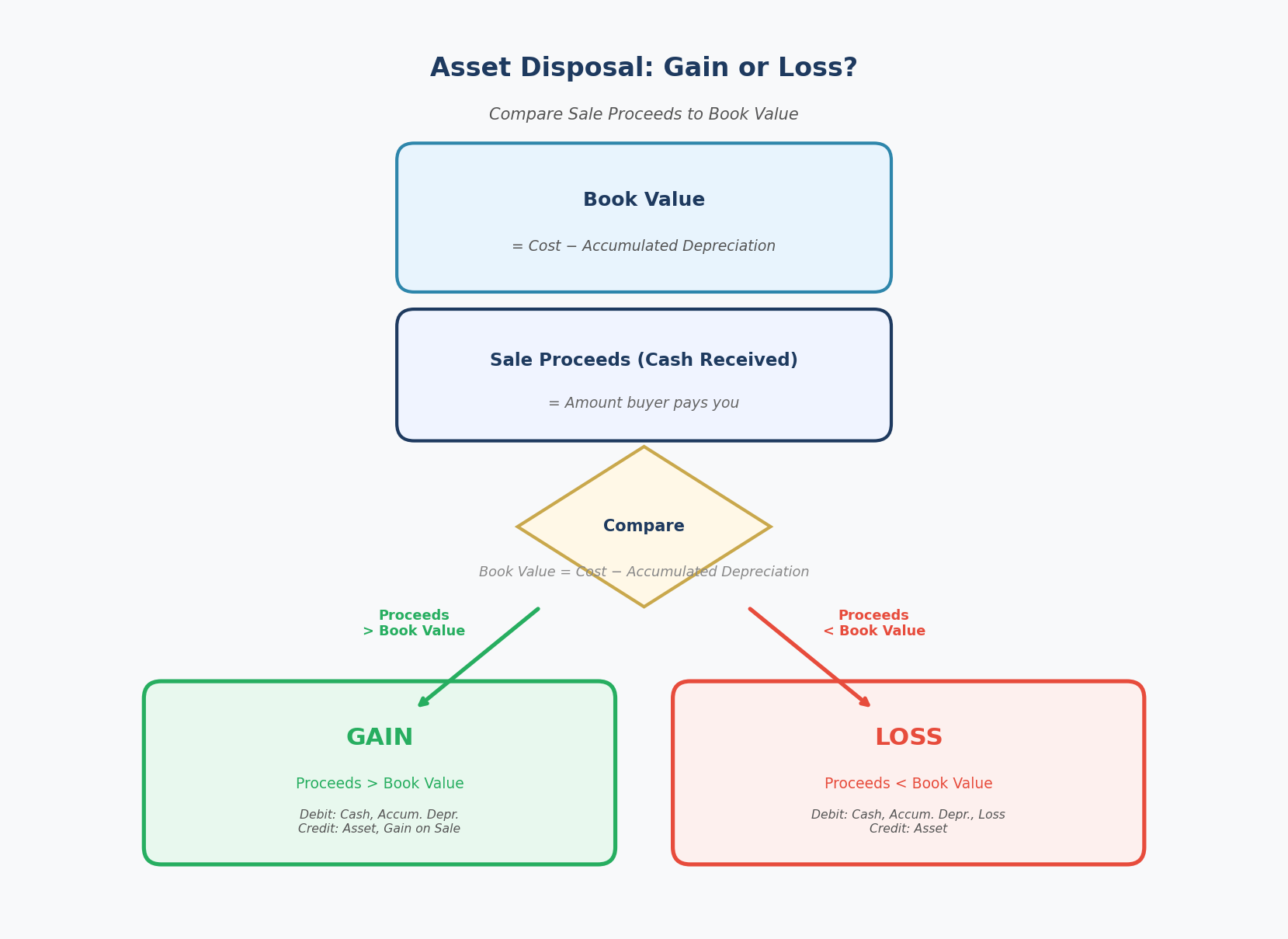
When an asset is sold, you must remove it from the books at its original cost, remove its accumulated depreciation, record the cash received, and recognize a gain or loss for the difference.
1
Book Value = Original Cost − Accumulated Depreciation
2
Compare sale proceeds to book value:
Proceeds > Book Value → Gain Proceeds < Book Value → Loss
3
Record the journal entry (see below)
Dr Cash (proceeds received) Dr Accumulated Depreciation — Equipment (accumulated to date) Dr Loss on Sale (plug, if proceeds < book value) Cr Equipment (original cost) Cr Gain on Sale (plug, if proceeds > book value)
🧠 The key mental shift: You are NOT comparing what you paid originally to what you sold it for. You are comparing what was still on the books (book value) to what you received. That's the gain or loss.
📝 Worked Example: Asset Disposal
<
5. Return on Assets (ROA) and Its Components
ROA measures how efficiently a company uses its assets to generate profit. It decomposes into two drivers: profit margin (how much profit per dollar of sales) and asset turnover (how many dollars of sales per dollar of assets).
ROA = Net Income ÷ Average Total Assets
Profit Margin = Net Income ÷ Sales
Asset Turnover = Sales ÷ Average Total Assets
ROA = Profit Margin × Asset Turnover
Average Total Assets = (Beginning Assets + Ending Assets) ÷ 2
🧠 The DuPont identity: ROA has two levers. A company can improve ROA by either (1) earning more profit per sale or (2) generating more sales per dollar of assets. A company with low margins but high turnover (like a grocery store) can have the same ROA as a company with high margins but low turnover (like a luxury jeweler).
🚨 Common Trap: Using ending assets instead of average assets. The phrase "average total assets" means exactly that — you need both beginning and ending balances. If only ending is given, some problems will accept ending as a proxy, but the correct approach uses the average.
Activity = (Cost − Residual) ÷ Total activity × Actual activity
Figure 7-1 [IMG-01] — All three methods spend the same total depreciable base on different schedules.
Goodwill = Purchase price − (FV assets − FV liabilities)
Book value at disposal = Cost − Accumulated depreciation
Figure 7-2 [IMG-02] — Compare sale proceeds to book value (not original cost).
ROA = Net income ÷ Average total assets
Profit margin = Net income ÷ Sales
Asset turnover = Sales ÷ Average total assets
Pre-Exam Checklist
I can capitalize vs. expense costs for land (including demolition)
I can allocate a basket purchase using relative fair values
I can compute depreciation under SL, DDB, and activity methods
I know why DDB produces the highest early-year expense
I know which intangibles get amortized and which don't
I can compute goodwill from a business acquisition
I can record an asset disposal and identify the gain or loss
I can compute ROA, profit margin, and asset turnover
I know the difference between book value and original cost