What Are Current Liabilities?
We turn our focus in this chapter to Current Liabilities. As a reminder, liabilities represent amounts — or value — we owe to someone outside of the organization. Current liabilities are those that are due within one operating cycle (as the word "currently" implies). Generally, this corresponds with liabilities due "within the next year," but in some cases it might be more than that if a company has a long operating cycle — like a shipbuilder, for instance. It takes a long time to build a large ship, so their operating cycle might be longer than a year.
There are lots of types of current liabilities. For example:
- Accounts Payable — amounts owed to suppliers for goods or services purchased on credit
- Notes Payable / Current Maturities of Long-Term Debt — formal promises to pay, including the portion of a long-term loan due soon
- Accrued Liabilities — expenses that have been incurred but not yet recorded or paid (interest, wages, taxes)
- Deferred Revenue — cash received before work is performed; a liability until the service is delivered
The core idea: If the company owes something and will likely pay it within the next year (or operating cycle), it's a current liability. Users of financial statements care about this because it tells them whether the company has enough short-term resources to meet its short-term obligations.
1. Notes Payable and the Interest Calculation
When a company takes out a loan, it debits Cash and credits Notes Payable. We got the cash now — but we owe someone money that needs to be paid back. If the loan spans more than one accounting period, we need to accrue the interest expense to include the cost of using the money even though we haven't paid the loan back yet.
Here's my "always works / never fails" way of calculating interest for ACC 202:
If we took out a $10,000 loan at 7% interest and need to accrue for 4 months of interest expense:
Or with a different note: a $150,000, 5%, 9-month note signed October 1, accrued through December 31 (3 months) = $150,000 × 5% × 3/12 = $1,875. The entry at December 31: Dr Interest Expense $1,875 / Cr Interest Payable $1,875. The key principle is the same: time fraction × rate × principal.
At period-end, we make an adjusting entry to recognize the interest expense we incurred — even though we haven't paid it yet:
Cr Interest Payable 233.33
🚨 Common Trap: Crediting Cash in the adjusting entry. When you're recording accrued interest at year-end, no cash changes hands. You're recognizing an expense you incurred but haven't paid yet. Cash only moves when the note matures. Crediting Cash would imply a payment was made — and no payment was made.
Paying Back a Note at Maturity
When loans come due, a company has to pay back the principal (original loan amount) plus interest. The entry would be:
Dr Interest Payable — clears out all accrued interest from prior periods
Dr Interest Expense — interest that applies to the most recent period (not yet recorded)
Cr Cash — the sum of principal + all interest now due
2. Payroll — The Two-Sided Picture
Payroll is kind of complicated. When we cut employees their checks, a whole lot more goes into it than just the hours they worked multiplied by the wages per hour. There's money the company withholds for taxes and benefits, and additional expenses the company pays for certain types of taxes and benefits. The amount the company withholds eventually gets forwarded to the government or benefits providers — but while the company has the employees' money, it sits as a current liability.
Net Pay = Gross Pay − Employee Withholdings (FICA + Income Tax + Benefits)
Employer Total Cost = Gross Pay + Employer Payroll Taxes + Employer Benefits
One employee has gross pay of $10,000 for the period. Withholdings: Employee FICA $765 (7.65%), federal income tax $1,800, health insurance $400. Employer also pays employer FICA $765 and unemployment tax $60.
Net Pay = $10,000 − $765 − $1,800 − $400 = $6,835
Entry 1 — Salaries Expense and Withholdings:
Cr FICA Taxes Payable (employee) 765
Cr Income Taxes Payable 1,800
Cr Health Insurance Payable 400
Cr Salaries Payable (net pay) 6,835
Entry 2 — Employer Payroll Taxes (separate entry):
Cr FICA Taxes Payable (employer) 765
Cr Unemployment Taxes Payable 60
The $825 in payroll tax expense is in addition to the $10,000 salaries expense. Total compensation cost to the employer: $10,825.
Coastal Services has one employee with gross pay of $14,000 for the period. Withholdings: Employee FICA $1,071 (7.65%), federal income tax $2,240, retirement contribution $700, health insurance $350. Employer pays employer FICA $1,071 and state unemployment tax $112.
Step 1 — Compute Net Pay:
− Employee FICA: $1,071
− Federal Income Tax: $2,240
− Retirement Contribution: $700
− Health Insurance: $350
= Net Pay: $9,639
Entry 1 — Salaries Expense and Withholdings:
Cr FICA Taxes Payable (employee) 1,071
Cr Income Taxes Payable 2,240
Cr Retirement Plan Payable 700
Cr Health Insurance Payable 350
Cr Salaries Payable (net pay) 9,639
Entry 2 — Employer Payroll Taxes:
Cr FICA Taxes Payable (employer) 1,071
Cr Unemployment Taxes Payable 112
Total compensation cost = $14,000 (salaries) + $1,183 (employer taxes) = $15,183. The employee takes home $9,639; the employer spends $15,183.
🚨 Common Trap: Mixing up employee and employer FICA. They are the same rate (7.65% each, totaling 15.3% for Social Security + Medicare) but they hit different accounts — employee FICA is withheld from the employee; employer FICA is an additional employer cost. Both are eventually paid to the government, but they come from different pockets.
3. Deferred Revenue and Sales Tax Payable
Deferred Revenue
When a company gets paid in advance for work it hasn't completed, it has a deferred revenue liability. When they initially get the cash:
Cr Deferred Revenue Liability
As they do the promised work, they debit the liability and credit revenue:
Cr Revenue
Think of it like a gift card — you loaded it, but you haven't spent it yet. The liability sits on the balance sheet until the service is delivered.
Sales Tax Payable
You go to Target and buy some decorations for your apartment. You pay the price on the shelf, plus sales tax. That sales tax doesn't belong to the store — so when Target collects it from you, they hold the money for a while until they're required to forward it to the government. While Target holds the sales tax money that is due to the government, it is counted as a current liability: Sales Tax Payable.
Cr Sales Tax Payable (sales tax collected, due to government)
Cr Sales Revenue (price, the store's actual earnings)
4. Contingent Liabilities — The New Ballgame
Much of the stuff so far in this chapter is similar to concepts we've covered earlier in the semester, just a bit more detailed into how businesses actually work. Contingent liabilities, however, are a whole new ballgame.
Sometimes we might — or might not — have to pay something. Or we might know we have to pay but not how much. These are contingent liabilities. A good example would be a lawsuit: we might lose... and if we do, we might have to pay a small or large amount. These types of events might be really important to investors and creditors as they make decisions about our company, so we need a system in place for properly notifying them.
When faced with a contingent liability, we assess our certainty of two things:
- Likelihood of Payment — How likely is it that we'll have to pay?
- Amount of the Payment — Do we know how much it will be?
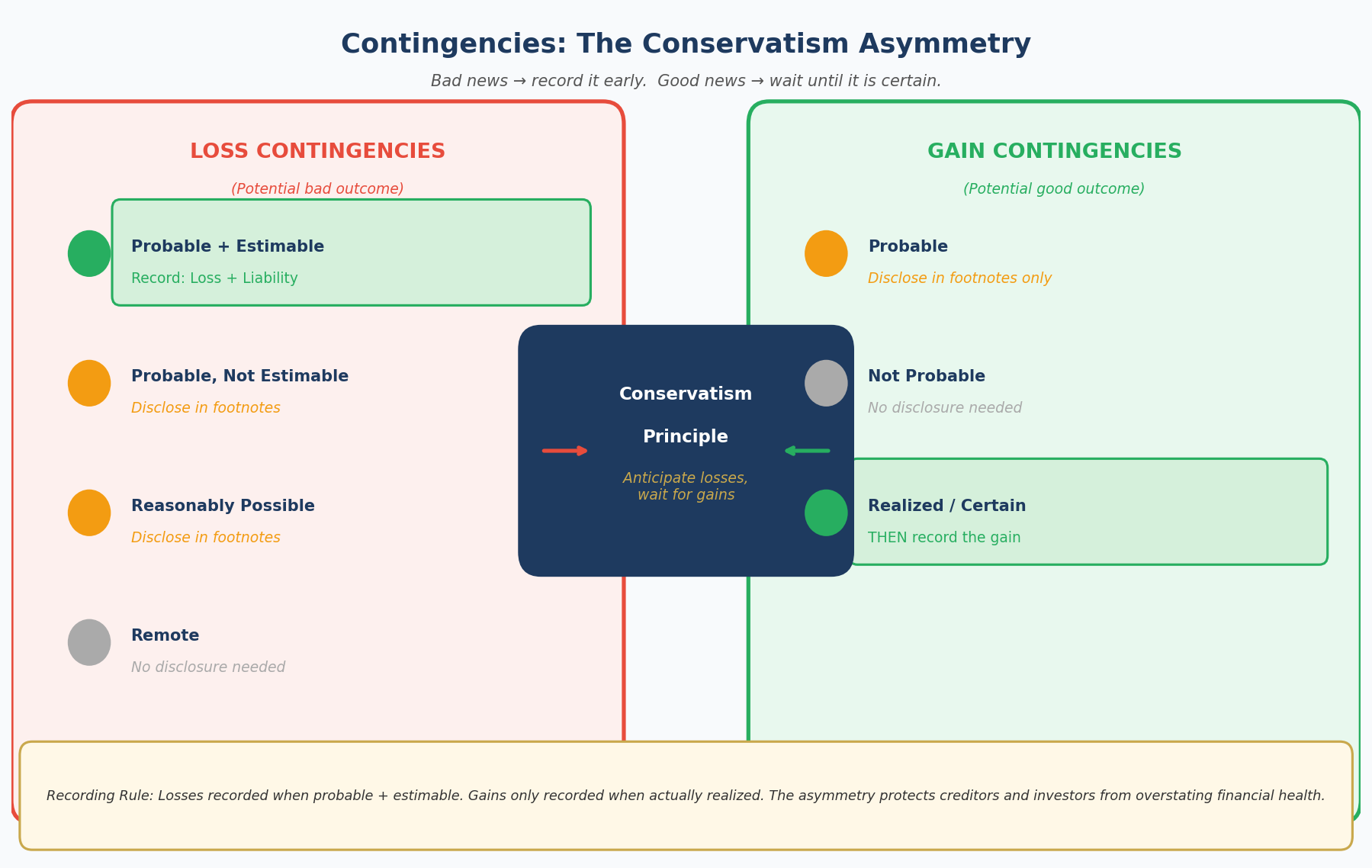
The Four Possibilities — And What to Do With Each
| Likelihood | Amount Known? | Accounting Treatment |
|---|---|---|
| Probable | Reasonably Estimable | ✅ Record a Loss + Record a Liability |
| Probable | Not Reasonably Estimable | 📋 Footnote Disclosure Only |
| Reasonably Possible | — | 📋 Footnote Disclosure Only |
| Remote | — | ❌ No Disclosure Required |
🧠 The Conservatism Asymmetry — remember this!
- Bad news early: If you might lose money and you can estimate it — record it now.
- Good news late: If you might gain money — don't record it until the cash is actually in hand.
Keeping with the Conservatism Principle in Accounting, we never record a contingent gain. We want a warning system in place to inform outsiders about potential contingent losses, but we don't ever want to make our company look better than it actually is.
🚨 Common Trap: Recording a gain contingency because the lawsuit "looks winnable." Even if victory is highly likely, gain contingencies are never recorded — only disclosed in footnotes if probable. Wait until you actually get the cash. This surprises students because it seems pessimistic, but it protects users from being misled by optimistic estimates.
Employee sues company for $2 million. Company's lawyers say: "We think we'll probably lose, and $2 million is a reasonable estimate."
- Defendant (company): Record Loss = $2M, Record Liability = $2M. Reason: probable and reasonably estimable.
- Plaintiff (employee): Do NOT record a receivable for the expected $2M. Gain contingencies are not recorded until realized.
Same lawsuit — different accounting treatment for each party. The company records a liability today; the plaintiff waits.
Warranties — A Special Kind of Contingent Liability
Warranties help sell products (because people are more willing to buy something with a warranty), so following the Accrual Accounting expense recognition principle, the cost of providing warranties is an expense that should be included along with the revenues they help produce. The problem is: at the time we sell the products, we don't know for sure how much warranty work we'll have to do or what it will ultimately cost us.
The solution: record Warranty Expense in the same period as the associated sales, based on an estimate of what we think warranty expenses are likely to be — typically based on the company's past experience with that product. We debit Warranty Expense and credit Warranty Liability. Think of this as a warranty allowance account, similar to the allowance for uncollectable accounts from earlier in the semester.
Cr Warranty Liability (a liability that sits on the balance sheet until claims come in)
As we actually begin to incur warranty claims, we debit the Warranty Liability account (using up some of the "allowance" we set up previously) and credit Cash for the actual cost of repairs:
Cr Cash / Parts / Labor (actual cost of the repair)
5. Ratios for Measuring Liquidity
All of this leads us to an important question: does the company have the necessary current assets to meet its current liabilities? These three ratios give us the answer.
A company has: Cash $50,000 · Receivables $30,000 · Inventory $80,000 · Prepaid $10,000 · Current Liabilities $100,000.
| Ratio | Formula | Result |
|---|---|---|
| Working Capital | $50K + $30K + $80K + $10K − $100K | $70,000 |
| Current Ratio | $170K ÷ $100K | 1.70 |
| Acid-Test Ratio | ($50K + $30K) ÷ $100K | 0.80 |
The Current Ratio of 1.70 looks healthy — but the Acid-Test of 0.80 reveals that without selling inventory, the company can't quite cover its current liabilities with its most liquid assets. That's why both ratios matter.
Long-Term Liabilities: Bonds and Installment Notes
When a company needs to raise large amounts of capital for long-term projects, it often turns to bonds or installment notes. These are fundamentally different from the short-term liabilities we've been talking about — they're due beyond one year, and they come with their own vocabulary, their own pricing mechanics, and their own risks.
6. Installment Notes
An installment note is a loan repaid in regular periodic payments — usually monthly or annually. Each payment covers: (1) interest on the outstanding balance, and (2) a reduction of principal. Early on, most of the payment is interest; later, most of it is principal as the balance shrinks.
Key concept — the amortization table: Each payment is split between interest expense (based on the outstanding balance at the beginning of the period times the interest rate) and principal reduction. Over time, the interest portion shrinks and the principal portion grows — but the payment amount stays the same.
Company signs a $60,000, 8%, 3-year installment note. Annual payments of $23,234 are made at year-end.
| Year | Payment | Interest (8%) | Principal | Balance |
|---|---|---|---|---|
| 0 (origination) | — | — | — | $60,000 |
| 1 | $23,234 | $4,800 | $18,434 | $41,566 |
| 2 | $23,234 | $3,325 | $19,909 | $21,657 |
| 3 | $23,234 | $1,577 | $21,657 | $0 |
Notice: interest decreases each year (smaller balance × same rate) while principal increases. The payment amount stays constant.
Timberline Construction signs a $120,000, 8%, 5-year installment note. Annual payments of $28,591 are due at each year-end.
Step 1 — Year 1 interest (at origination, no prior balance):
Step 2 — Principal reduction in first payment:
Step 3 — Year-end journal entry:
Dr Notes Payable 18,991
Cr Cash 28,591
Step 4 — Carrying value after Year 1:
The key pattern: interest portion shrinks each year (8% of a shrinking balance), while principal portion grows. By Year 5, nearly the entire payment is principal.
For Q15-style questions: The carrying value of the note decreases by the principal portion of each payment — not by the full payment amount. For example: $200,000 balance, 5% annual rate, $3,220.99 monthly payment → first month interest = $200,000 × 5% × 1/12 = $833.33; principal reduction = $3,220.99 − $833.33 = $2,387.66. That $2,387.66 is exactly how much the carrying value decreases.
Coastal Services has three employees with the following pay for the period. Record the journal entries for the payroll and the employer's payroll tax expense.
| Employee | Gross Pay | Federal Income Tax | Social Security (6.2%) | Medicare (1.45%) | Health Insurance | Net Pay |
|---|---|---|---|---|---|---|
| Ali | $4,000 | $800 | $248 | $58 | $150 | $2,744 |
| Bo | $5,500 | $1,100 | $341 | $79.75 | $200 | $3,779.25 |
| Cam | $4,500 | $900 | $279 | $65.25 | $175 | $3,080.75 |
| Totals | $14,000 | $2,800 | $868 | $203 | $525 | $9,604 |
Entry 1 — Record salaries expense (employer perspective):
Cr FICA Tax Payable 868
Cr Medicare Tax Payable 203
Cr Employee FIT Payable 2,800
Cr Health Insurance Premiums Payable 525
Cr Salaries Payable 9,604
Entry 2 — Record employer's matching FICA and Medicare:
Cr FICA Tax Payable 868
Cr Medicare Tax Payable 203
Note: Unemployment taxes (FUTA/SUTA) are additional employer costs recorded separately when applicable. The employer also typically matches the employee's health insurance contribution.
7. Lease Accounting Under Current Standards (ASC 842)
Under current accounting standards, the old "capital lease vs. operating lease" distinction has been replaced. The key change: virtually all leases longer than 12 months must now be recognized on the balance sheet — no more off-balance-sheet operating leases for most transactions.
The big shift: Under the old ASC 840 rules, operating leases were kept off the balance sheet. Under ASC 842, if a lease is for more than 12 months, the lessee records a Right-of-Use (ROU) Asset and a corresponding Lease Liability — regardless of whether it's a finance lease or an operating lease.
Finance Leases vs. Operating Leases — Current Rules
The distinction now primarily affects how expense is recognized on the income statement, not whether the lease appears on the balance sheet.
| Finance Lease | Operating Lease | |
|---|---|---|
| Balance sheet | ✅ ROU Asset + Lease Liability (PV of payments) | ✅ ROU Asset + Lease Liability (PV of payments) |
| Income statement | Front-loaded: interest expense (declining) + amortization (straight-line) — total expense higher early | Straight-line: single lease expense each period, evenly spread |
| Balance sheet presentation | ROU Asset often shown separately; liability split current/non-current | Single lease liability, also split current/non-current |
| Also called (old rules) | Capital lease | Operating lease |
🧠 Why the old rules still matter for tests: Many exam questions are still written against older material. When you see the old "4 criteria" (title transfer, ≥75% life, PV ≥ 90% of FV, or lease term ≥ 75% of useful life) — those still determine whether a lease is a finance lease under ASC 842, not whether it goes on the balance sheet. Today, virtually all long-term leases go on the balance sheet. The old criteria just determine what type of expense pattern applies.
🚨 Most common outdated mistake: Assuming operating leases stay off the balance sheet. Under current GAAP (ASC 842), they do not. If you see this in an older exam or test bank, treat it as a finance-vs-operating distinction, not a "on vs. off" balance sheet question.
8. Bonds — Characteristics and Vocabulary
A bond is essentially a large loan that a company (or government) issues to many investors at once. The company borrows money from the public and promises to pay interest periodically and return the principal at maturity. Understanding bonds starts with knowing the vocabulary:
| Characteristic | Definition |
|---|---|
| Secured | Bonds backed by collateral — if the issuer can't pay, bondholders have a claim on specific assets. |
| Unsecured | Bonds not backed by collateral — bondholders rely solely on the issuer's creditworthiness. Also called "debentures." |
| Term | The bond issue matures on a single, pre-determined date. All principal is due at once at maturity. |
| Serial | The bond issue matures in installments — some principal is paid back each year, so investors face less "lump sum" reinvestment risk. |
| Callable | The issuing company has the right to pay off the bonds early — typically when interest rates have fallen, allowing them to refinance cheaper. |
| Convertible | The investor has the right to convert bonds into common stock — attractive if the company's stock price rises significantly. |
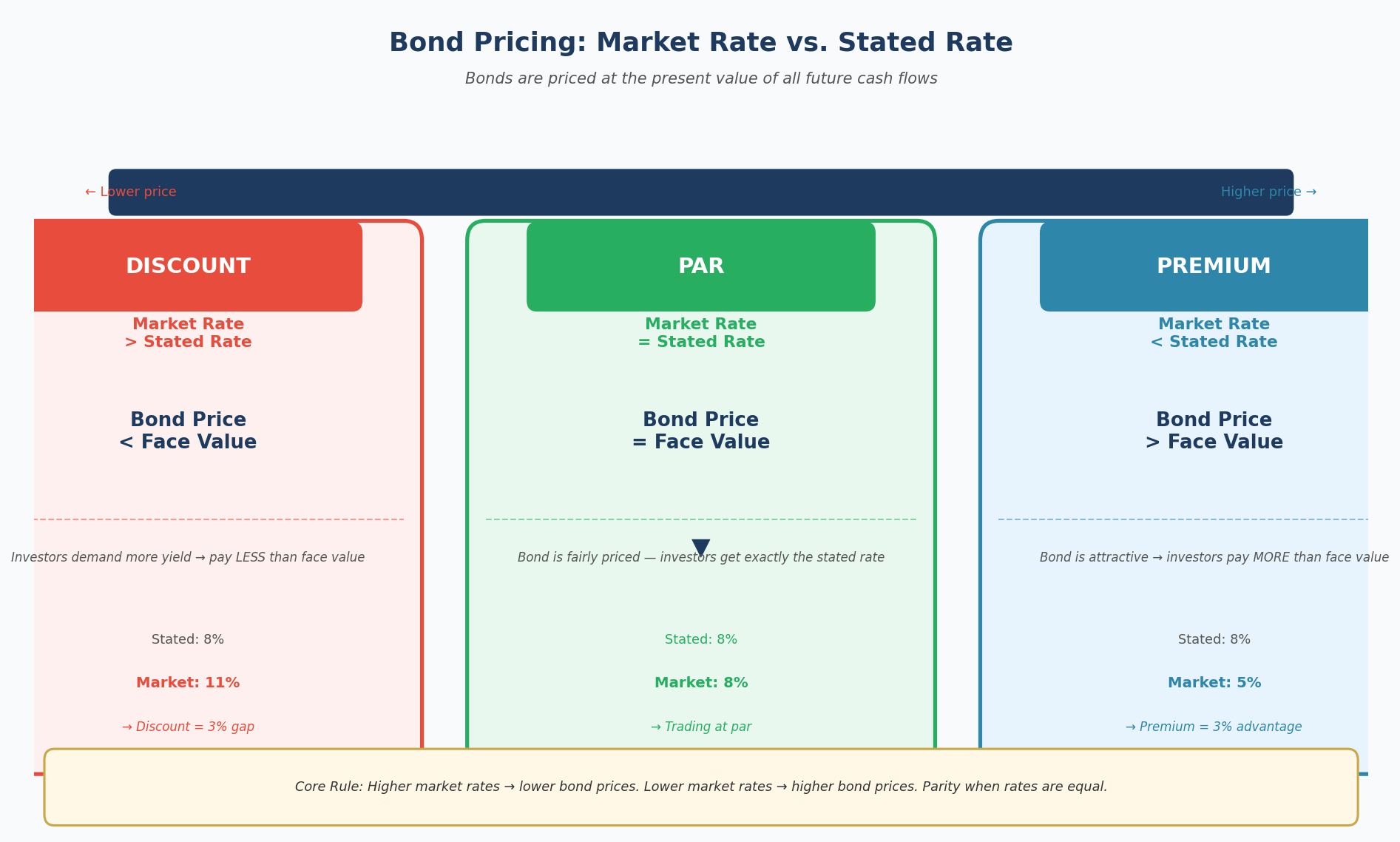
9. Why Bonds Sell at Par, Discount, or Premium
Bonds have a stated interest rate (also called face rate or coupon rate) — the rate printed on the bond that determines the dollar amount of interest paid each period. But investors compare this to the market interest rate — what similar investments are actually yielding in the market today.
Bond Issued at Par (Face Value):
Stated Rate = Market Rate → Bond price = Face value (typically $1,000 per bond)
Bond Issued at a Discount:
Stated Rate < Market Rate → Investors won't pay full price for lower interest → Bond sells for less than face value. The discount is the extra yield investors demand.
Bond Issued at a Premium:
Stated Rate > Market Rate → Bond pays more than market → Investors pay more than face value to get that above-market rate.
🧠 The intuition: Think of it like buying a smartphone on sale. If the market interest rate (the "going rate") rises above what your bond pays, your bond becomes less attractive — so you have to discount the price to compensate. If your bond pays more than the market rate, it's like a bonus — investors will bid the price up above face value. We cover this at a concept level — you will not need to calculate the discount or premium amount on this exam.
10. Ratios for Long-Term Debt Risk
Two ratios help investors and creditors measure how much long-term debt a company is carrying relative to its size and its ability to service that debt.
Company has: Total Liabilities = $500,000 · Total Equity = $250,000 · EBIT = $120,000 · Interest Expense = $20,000 · Income Tax Expense = $25,000 · Net Income = $75,000.
| Ratio | Calculation | Result |
|---|---|---|
| Debt to Equity | $500K ÷ $250K | 2.0 |
| Times Interest Earned | ($75K + $20K + $25K) ÷ $20K | 6.0× |
A D/E of 2.0 means the company uses twice as much debt as equity — leveraged, but not unusual. A TIE of 6.0× means operating earnings cover the interest expense 6 times over — very comfortable coverage.
Quick Reference — All Ratios in One Place
| Ratio | Formula | What It Measures |
|---|---|---|
| Working Capital | Current Assets − Current Liabilities | Short-term liquidity cushion ($) |
| Current Ratio | Current Assets ÷ Current Liabilities | Short-term liquidity (×) |
| Acid-Test Ratio | (Cash + Securities + Receivables) ÷ Current Liabilities | Immediate liquidity, excl. inventory (×) |
| Debt to Equity | Total Liabilities ÷ Total Equity | Financial leverage / long-term risk |
| Times Interest Earned | (NI + Int + Tax) ÷ Interest Expense | Ability to service long-term debt (×) |